
Clamshell Containers for Hot Food: Materials and Closures
Published
Hot takeout needs more than a compostable label. Compostable clamshell containers can package fruits, vegetables, frozen seafood, BBQ ribs, cookies, burgers, sandwiches, and pies. But clear PLA clamshells can melt at 105 degrees and aren’t designed for warm or hot foods.
That distinction matters when a meal travels from the kitchen to the customer. The right clamshell containers depend on the food, material, and closure. A format suited to a cool sandwich may not work for a hot meal.
This guide explains which foods may suit compostable clamshell containers and how fiber materials, shape, compartments, and closures affect takeout use. You’ll learn what to consider when matching packaging to menu items, containing meals, and choosing a practical format for service. The focus is on design decisions that help prevent spills and mismatched packaging during busy shifts.
Key Takeaways
- Match the container’s material to the food’s heat, moisture, and handling needs to support reliable takeout service.
- Compare fiber-based options by how their material and construction suit your menu and packing workflow.
- Understand how the base, lid, and compartments affect portioning, separation, and transport.
- See how closure design helps keep meals contained, and why a closed lid is not the same as a tamper-evident seal.
- Learn why compostability and recyclability depend on the material, certification claims, and available disposal pathways in the Philippines.
Table of Contents
What types of foods can be used in compostable clamshell containers?
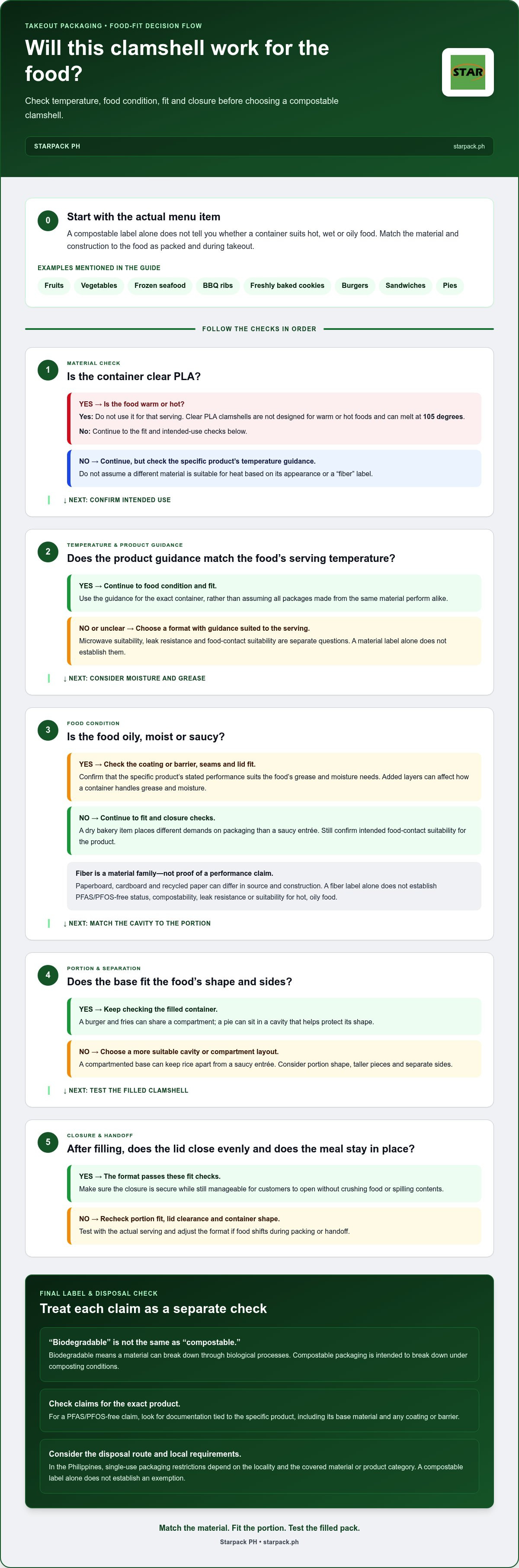
Match a compostable container to the food’s temperature, moisture, shape, and travel needs. Suitable examples include fruits, vegetables, frozen seafood, BBQ ribs, freshly baked cookies, burgers, sandwiches, and pies. Material still matters: clear PLA clamshells can melt at 105 degrees and aren’t designed for warm or hot foods.
A clamshell has a lower section and a lid that opens and closes over it. Restaurants and fast-food businesses use this format for individual meals to go. A burger and fries can share a compartment, while a pie can sit in a cavity that helps protect its shape. The attached lid keeps the sections together during packing and handoff.
Choose by use, not by the compostable label alone. Match material to serving temperature, then consider whether the food is oily, moist, fragile, or likely to shift. A salad and a cookie have different handling needs from BBQ ribs. For pasta takeout, portion shape and containment matter too. This guide to pasta choices for restaurant takeout covers another format consideration.
“Biodegradable” and “compostable” describe different things. Biodegradable means a material can break down through biological processes. Compostable packaging is intended to break down under composting conditions. Neither term alone tells you whether a container suits hot, wet, or oily food. Consider the material claim alongside the menu item and the disposal route available to customers.
Clamshell packaging has a long history. American inventor Thomas Jake Lunsford first patented it in 1978. Its hinged form became useful in food service because it holds products inside a closeable shell. Yet a closure that stays shut can be difficult for customers to open. For diners handling a meal away from a table, a secure lid should still be manageable without crushing the food or spilling its contents.
In the Philippines, businesses must follow applicable rules on single-use packaging. Restrictions depend on the relevant locality and the material or product category covered. A compostable label alone doesn’t establish that a package is exempt. Consider the container material and applicable local requirements when selecting packaging for a menu item.
To make a practical selection, test the filled container with the actual serving. Check temperature suitability, food fit, lid clearance, and whether the meal shifts during handoff. A container that holds a cookie may not suit a hot entrée. Reviewing these factors together helps food businesses choose a format that fits both the menu and takeout routine.
Are there PFAS/PFOS Free Fiber Clamshell Containers?
Fiber formats are one option alongside plastic, Styrofoam, paperboard, cardboard, and recycled paper. The material and manufacturing method influence a container’s structure and intended use.
Materials and Manufacturing Methods
Material and manufacturing methods describe what a package is made from and how it takes shape. Fiber clamshells may use paperboard, cardboard, or recycled paper. Manufacturers can mold fiber pulp into a shell or cut and fold paperboard into a hinged form. Plastic packaging is shaped differently. These choices affect rigidity, rim alignment, and how the lid meets the base.
“Fiber” names a material family, not its source or any treatment applied to it. Paperboard and cardboard can contain virgin or recycled fiber, while recycled-paper packaging uses recovered paper material. For businesses choosing packaging to support environmental goals, these distinctions clarify what a material claim describes. A fiber label alone doesn’t establish whether a specific product is PFAS/PFOS-free, compostable, or suitable for a hot, oily meal.
Food Safety and Container Performance
Microwave suitability, leak resistance, and food-contact suitability are separate performance questions. The material and construction determine a package’s intended use, so don’t infer microwave suitability or leak resistance from a fiber label. Food-contact suitability also relates to the specific product, not simply its paper or plastic appearance.
For a PFAS/PFOS-free claim, look for documentation tied to the exact product. A general claim about fiber packaging doesn’t establish the status of every shell made from paperboard, cardboard, or recycled paper. Consider what the statement covers, including the base material and any coating or barrier. Those added layers can affect how clamshell containers handle grease and moisture, so compare them with the menu item’s needs.
Use the intended food to assess performance. A dry bakery item places different demands on packaging than a saucy entrée. Surface coatings, seams, and lid fit affect containment, while heat and moisture challenge the material. Compare intended food contact, temperature guidance, grease resistance, closure fit, and disposal claims. Each property answers a different operational question; no single label covers them all.
For example, don’t automatically use a package selected for a room-temperature cookie for a hot, oily meal. Match the package to the food’s condition at packing and during takeout. Also check whether the lid closes evenly after filling and whether the stated disposal route fits local handling. These checks make material claims more useful at the kitchen line.
Browse food packaging options and compare materials and formats with your menu’s needs.
Clamshell container design
A clamshell has a lower section and a lid that opens and closes over it. Its design affects portion fit, food separation, packing speed, and how well a meal travels. For hot takeout, assess the base and lid together, not just the container’s outside dimensions.
Start with the portion. A flat sandwich needs a different cavity shape from a meal with taller pieces or separate sides. A compartmented base can keep rice apart from a saucy entrée, while a single cavity suits food served together. Check that the lid clears the food instead of pressing toppings, breading, or other delicate parts.
Footprint and depth matter during handoff and delivery. One listed clear plastic tray measures 6 by 6 by 3.15 inches; a compostable option measures 9 by 6 inches. Those measurements illustrate different footprints, not interchangeable capacity. Compare the actual packed portion with the base’s usable area and depth. Extra room can reduce crushing, but an oversized package can let food shift during transport.
Edges and corners also shape the packing experience. A wide opening gives staff room to place a meal without catching it on the rim. A defined rim can help the lid meet the base consistently. For a burger with a side, check whether both fit without bending the food or forcing the lid down. Trial packing with the actual serving helps reveal fit problems before service.
Compartments add structure, but they don’t suit every menu. Separate sections can keep dry sides away from sauces; a single open base gives larger portions more room. Consider how the layout affects serving and eating as well as packing. A container that divides a meal poorly can mean more handling for kitchen staff and customers.
Design development has addressed structural problems for decades. Patent US 4792085 for a buckle-proof clamshell container was published on 1988-12-20. The patent’s stated focus highlights a practical design concern: a shell should hold its shape rather than buckle during handling. For current food service, inspect the base, hinge, rim, and lid alignment as one system. If the lid flexes or misses the rim, closure can become inconsistent.
On a busy line, test the format with the menu’s most awkward portion, such as a tall burger or a side placed beside an entrée. Check the filled container for lid clearance, stable stacking, and easy opening. A good fit supports a repeatable packing routine. Choose a design that holds the intended serving without crowding it or adding unnecessary handling.
Closure and sealing methods
A closure holds the lid against the base during packing and transport. A seal adds another barrier across the opening, often using a separate strip or label. For a burger packed for delivery, the lid’s fit helps contain the meal, while a tamper-evident label can show whether someone opened the package after packing.
Many hinged food containers use a formed edge, tab, or rim that presses into place when the lid closes. This snap-fit design keeps the lid and base connected without a separate fastener. Staff should press along the rim, rather than only at one corner, so each edge meets its corresponding channel. A corner left open can catch during stacking or handling.
Closure design has also evolved to support both permanent and resealable fastening. Patent US 6227369 for a clamshell package with permanent and resealable fastening structures was published on 2001-05-08. That distinction matters in takeout: a package intended to remain closed after packing serves a different purpose from one customers may reopen and close, such as a container holding a snack to eat in stages.
Choose a fastening method based on the food and the trip. A molded tab can suit a dry sandwich that needs a straightforward lid closure. A separate adhesive label can provide visible evidence across the opening, but it won’t correct a poorly aligned rim. For a saucy entrée, the container’s construction and fit still matter. Don’t treat a sticker alone as leakproof protection.
Test closures with the actual serving, not an empty sample. Place the meal inside, close the lid, and check the full perimeter for gaps or lifted corners. Then handle the packed container as staff would during a normal handoff. For example, gently tilt a closed container holding a dry item to see whether the lid releases. This isn’t proof that liquid meals won’t leak.
Heat and trapped steam can also affect the customer experience. A tightly closed package may retain heat, while moisture can collect inside and soften foods such as crisp fried coating. The closure doesn’t control food texture on its own; ventilation, food condition, and travel time also influence the result. Choose a lid style that balances containment with the menu item’s need to release steam.
Build a quick closure check into packing: align the hinge, close the lid, press around the rim, and inspect the corners. For a multi-item order, confirm that each container stays shut beside the others. Consistent checks help staff spot a mismatched lid or damaged tab before the package leaves the counter.
Are clamshell containers recyclable or compostable in the Philippines?
Disposal depends on the container’s material and the waste pathway available where it’s used. A plastic shell, molded-fiber shell, and coated paperboard box shouldn’t be treated as interchangeable after a meal.
Plastic containers may be recyclable where the material is accepted and handled by a local collection or recycling program. A recycling symbol or plastic appearance alone doesn’t establish that a used food package will be collected. Food residue, grease, labels, and mixed materials can affect sorting and processing. A clean, empty plastic shell presents a different sorting challenge from one holding sauce or stuck-on food.
Fiber packaging can be compostable, but the claim belongs to the specific product, not every item that looks like paper. Some certified compostable clamshells meet BPI standards or ASTM 6400/6868. Those standards provide a basis for a compostability claim; they don’t mean a container belongs in ordinary recycling. Keep compostable items separate from recyclable plastic so the materials don’t get mixed during collection.
In the Philippines, the practical disposal route depends on what local waste services accept. A compostable package needs suitable composting conditions to break down as intended. If a food business serves several communities, disposal access may vary between customers. For example, one location may have a composting collection route, while another may rely on general waste collection. The same label doesn’t create the same disposal outcome everywhere.
Use a simple material check before setting staff instructions:
- Plastic: Identify the material and follow local recycling acceptance rules; remove food residue where required.
- Fiber: Look for a product-specific compostability claim and its stated standard, such as ASTM 6400/6868.
- Mixed construction: Check whether a lining, coating, or attached label changes the disposal route.
Clear customer instructions can reduce sorting errors. A label that says “compostable” without explaining the intended route may lead customers to put the package in the wrong bin. Separate bins for compostables, recyclables, and general waste work only when their labels match what local collection accepts. At takeout counters, staff can also remove food scraps before sorting packaging.
Don’t select a hot-food container based on disposal claims alone. Match the material to the food and heat, then consider local collection or composting access. A package that suits a saucy entrée but has no practical disposal route may not fit the operation’s waste plan. Review packaging formats alongside the disposal process at each service location.
Starpack PH: Spaghetti Box 500ml
Starpack PH offers food packaging options for businesses matching takeout formats to menu items. For pasta portions, the Spaghetti Box 500ml gives operators a named format to consider; for other meals, the Clamshell 700 Brown Silver is another available option. Select by the food’s portion, temperature, moisture, and packing needs, rather than assuming one container suits every dish.
The Kraft Salad Bowl 500ml and Paper Cup 8oz serve different packaging roles, helping businesses plan beyond a single meal container. Compare the formats with your menu and daily packing workflow to keep procurement practical and consistent.
For packaging options, visit starpack.ph or contact Starpack PH.
Make Your Packaging Choice Work on the Line
Make packaging selection a practical part of service planning. Identify the menu items that create the most packing friction, then match each format to portion size, food type, and handoff needs. A clear approach helps staff make consistent choices during busy shifts. Review packaging as the menu changes, not just when supplies run low.
Starpack PH offers the Spaghetti Box 500ml, Paper Cup 8oz, and Kraft Salad Bowl 500ml. These formats suit different menu roles, from pasta and drinks to salads. Consider them alongside the clamshell containers used for other takeout items, so each order has packaging suited to its contents and service workflow.
Use your next purchasing decision to build a practical mix for the food you serve. Keep portion fit, packing routines, and customer handoff in view. A focused selection can make day-to-day packaging easier to manage.
Choose formats that fit your operation and help keep your next service moving with confidence.
Frequently Asked Questions
What is clamshell packaging?
Clamshell packaging has two connected sections, typically a base and a lid. The lid folds over the base to enclose a product, creating one unit for packing and handling. In food service, this format can hold a single serving, such as a sandwich or side dish. Its hinged construction keeps the lid attached, which can simplify packing compared with separate-lid packaging.
What is the difference between biodegradable clamshells and compostable clamshells?
Biodegradable describes material that can break down through biological processes, while compostable packaging is designed to break down under composting conditions. The terms don’t establish the same disposal route. For example, a package described as biodegradable doesn’t automatically belong in a compost collection bin. For compostable products, look for a product-specific claim and supporting standard, such as ASTM 6400/6868 or BPI certification.
What are clamshell containers and what materials are they made from?
Clamshells are hinged packages with a base and closing lid, made from materials such as plastic, Styrofoam, paperboard, cardboard, or recycled paper. Material choice affects how a package handles food and its disposal route. For instance, a clear plastic shell and a molded-fiber package may look and perform differently. Check the product’s material and intended use rather than relying on its shape or appearance.
What sizes and types of clamshell containers are available in the Philippines?
Options can differ by capacity, footprint, depth, compartment layout, and material. A single-compartment format may suit a sandwich, while divided sections can separate a main dish from sides. In the Philippines, match the package to the portion and packing workflow rather than choosing by outside measurements alone. Compare usable space, lid clearance, and the fit of the actual serving before settling on a format.
How much do clamshell containers cost in the Philippines?
Cost depends on material, size, construction, and pack quantity. Compare the same type of package and quantity, rather than one-piece pricing with a bulk pack. Food businesses should also consider whether a container fits the serving and packing process. An unsuitable size can create waste or require extra packaging, affecting the overall purchasing decision.
Which clamshell containers are suitable for hot food, cold food, or takeout?
Choose according to the food’s temperature and handling needs. Clear PLA clamshells can melt at 105 degrees and aren’t designed for warm or hot food. For any other material, use its stated temperature guidance and intended food use. For cold items such as fruit or a sandwich, consider moisture and movement during transport. Takeout also calls for a lid that closes securely around the filled portion.
How do plastic, paperboard, and compostable clamshell containers compare?
Plastic, paperboard, and compostable describe different material or disposal attributes, so compare specific products rather than assuming each category performs uniformly. Plastic can be clear, while paperboard and fiber formats are opaque. A compostability claim concerns disposal conditions, not automatic suitability for hot or oily food. Assess food contact, heat guidance, closure fit, and the waste route available where customers will dispose of the package.
What are the environmental and food-safety risks of clamshell containers?
Environmental concerns include choosing packaging that local waste services cannot process or mixing compostable and recyclable materials during disposal. Food-safety considerations include using a container outside its intended food-contact or temperature guidance. For example, packaging designed for cold items may not suit a hot meal. Keep food residue and handling practices in mind, and match the material to the food and disposal route.
Frequently asked questions
What is clamshell packaging?
Clamshell packaging has two connected sections, typically a base and a lid. The lid folds over the base to enclose a product, creating one unit for packing and handling. In food service, this format can hold a single serving, such as a sandwich or side dish. Its hinged construction keeps the lid attached, which can simplify packing compared with separate-lid packaging.
What is the difference between biodegradable clamshells and compostable clamshells?
Biodegradable describes material that can break down through biological processes, while compostable packaging is designed to break down under composting conditions. The terms don’t establish the same disposal route. For example, a package described as biodegradable doesn’t automatically belong in a compost collection bin. For compostable products, look for a product-specific claim and supporting standard, such as ASTM 6400/6868 or BPI certification.
What are clamshell containers and what materials are they made from?
Clamshells are hinged packages with a base and closing lid, made from materials such as plastic, Styrofoam, paperboard, cardboard, or recycled paper. Material choice affects how a package handles food and its disposal route. For instance, a clear plastic shell and a molded-fiber package may look and perform differently. Check the product’s material and intended use rather than relying on its shape or appearance.
What sizes and types of clamshell containers are available in the Philippines?
Options can differ by capacity, footprint, depth, compartment layout, and material. A single-compartment format may suit a sandwich, while divided sections can separate a main dish from sides. In the Philippines, match the package to the portion and packing workflow rather than choosing by outside measurements alone. Compare usable space, lid clearance, and the fit of the actual serving before settling on a format.
How much do clamshell containers cost in the Philippines?
Cost depends on material, size, construction, and pack quantity. Compare the same type of package and quantity, rather than one-piece pricing with a bulk pack. Food businesses should also consider whether a container fits the serving and packing process. An unsuitable size can create waste or require extra packaging, affecting the overall purchasing decision.
Which clamshell containers are suitable for hot food, cold food, or takeout?
Choose according to the food’s temperature and handling needs. Clear PLA clamshells can melt at 105 degrees and aren’t designed for warm or hot food. For any other material, use its stated temperature guidance and intended food use. For cold items such as fruit or a sandwich, consider moisture and movement during transport. Takeout also calls for a lid that closes securely around the filled portion.
How do plastic, paperboard, and compostable clamshell containers compare?
Plastic, paperboard, and compostable describe different material or disposal attributes, so compare specific products rather than assuming each category performs uniformly. Plastic can be clear, while paperboard and fiber formats are opaque. A compostability claim concerns disposal conditions, not automatic suitability for hot or oily food. Assess food contact, heat guidance, closure fit, and the waste route available where customers will dispose of the package.
What are the environmental and food-safety risks of clamshell containers?
Environmental concerns include choosing packaging that local waste services cannot process or mixing compostable and recyclable materials during disposal. Food-safety considerations include using a container outside its intended food-contact or temperature guidance. For example, packaging designed for cold items may not suit a hot meal. Keep food residue and handling practices in mind, and match the material to the food and disposal route.