Choosing a Disposable Food Tray for Catering Service Lines
Published
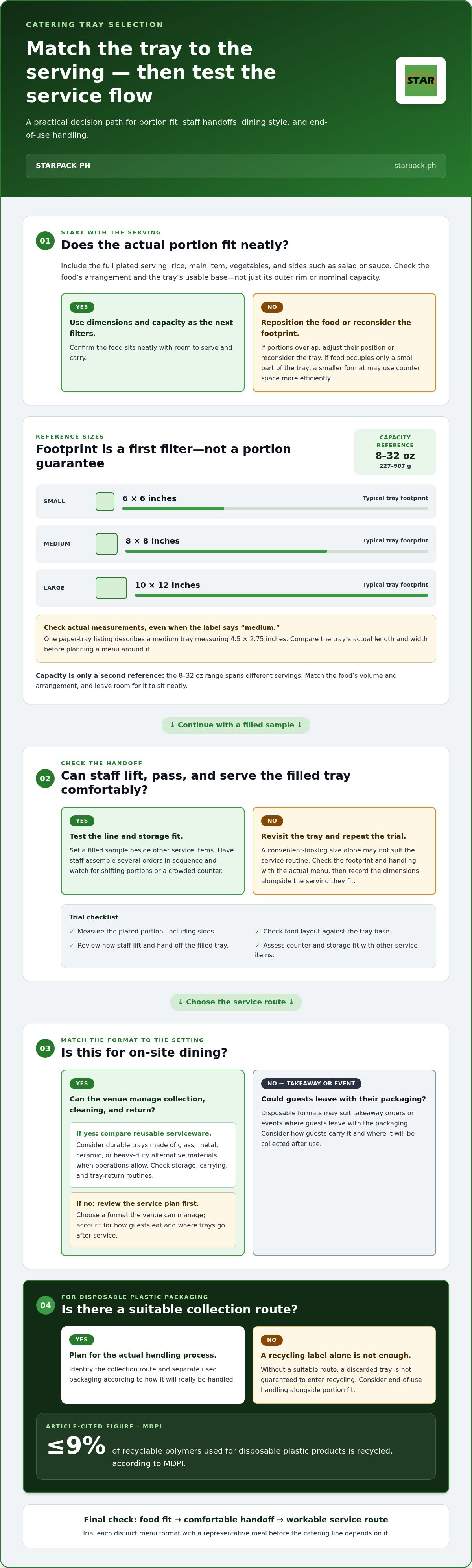
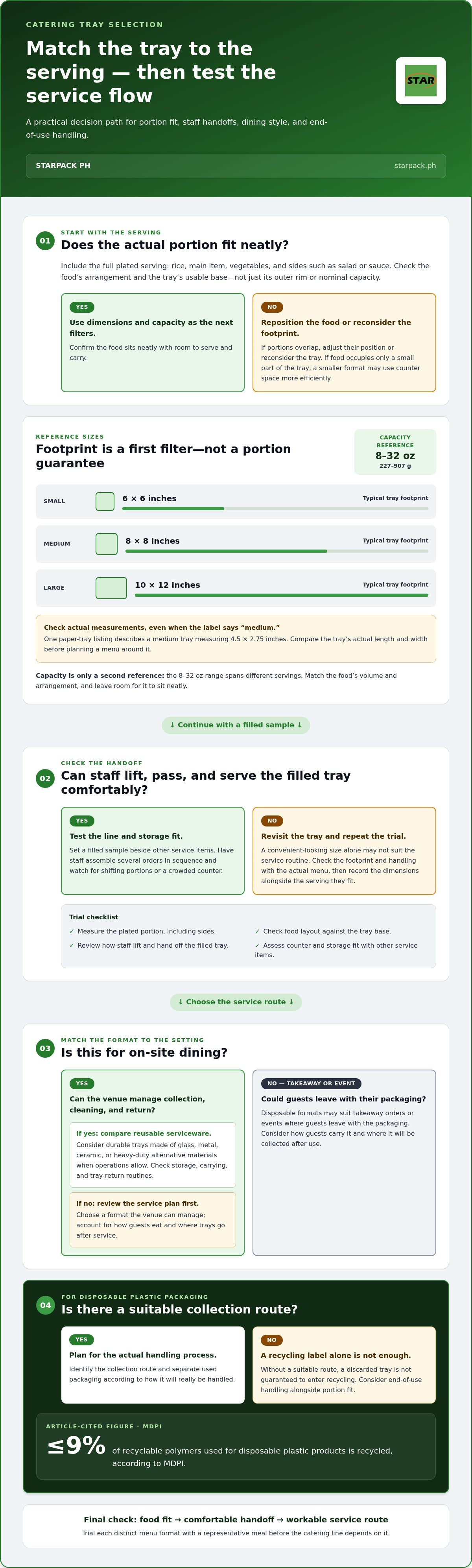
The largest tray isn’t always the safest choice for a catering line. Match the disposable food tray to the portion: typical small trays measure 6 x 6 inches, medium trays 8 x 8 inches, and large trays 10 x 12 inches. Standard disposable food packaging trays commonly hold around 8-32 ounces, so serving size helps narrow the fit.
Capacity matters, but tray dimensions also affect how food sits, how staff serve it, and how smoothly the line moves. A tray that’s too small can crowd a portion; one that’s too large can take up valuable counter and storage space. Choose based on the food, serving style, and whether the tray is for takeaway or on-site dining.
This guide explains how to compare tray size, capacity, material, and handling needs for a catering operation in the Philippines. Use these details to match packaging to your menu and service flow, plan what to order, and keep supplies organised.
Key Takeaways
- Match the tray’s shape and usable space to the food’s layout, not just the portion volume.
- Consider how staff will carry, plate, and hand off each serving during the catering line’s busiest moments.
- Choose packaging material with the disposal route in mind; according to MDPI, no more than 9% of recyclable polymers used for disposable plastic products is recycled.
- For menu items such as spaghetti, compare packaging options by how well they suit the food and serving format.
- Review the tray choice alongside the rest of your service packaging to keep the line practical and consistent.
Table of Contents
Disposable food tray
Start with the serving, not the container. For a rice meal with grilled fish and vegetables, check that the portions fit without crowding or mixing. Then consider how staff will place, carry, and hand off the meal. The right disposable food tray supports both the menu and the service routine; a convenient-looking size alone may not.
Use dimensions as a first filter. Typical small, medium, and large tray footprints are 6 x 6 inches, 8 x 8 inches, and 10 x 12 inches. These are reference sizes, not portion guarantees. A paper-tray listing also describes a medium tray measuring 4.5 x 2.75 inches, showing why labels such as “medium” can differ. Compare actual length and width before planning a menu around a tray.
Capacity gives a second reference. Standard disposable food packaging trays commonly hold around 8-32 ounces, or 227-907 grams. That range spans different servings, so match capacity to the food’s volume and arrangement. A compact dessert portion and a meal with rice, protein, and sides need different usable space. Leave room for the food to sit neatly, rather than choosing only by a nominal capacity.
- Measure the serving: Use the actual plated portion, including sides such as salad or sauce.
- Check the footprint: Compare the food’s layout with the tray’s base, not just its outer rim.
- Review the handoff: Consider whether staff can lift and pass the filled tray comfortably.
- Test the stack: Set a filled sample beside the other service items to assess counter and storage fit.
Test a representative order before committing to a service-line setup. Starpack PH recommends that caterers arrange rice, a main item, and vegetables as staff would serve them. If portions overlap, adjust their position or reconsider the tray’s footprint. If the food occupies only a small part of the tray, a smaller format may use counter space more efficiently. Repeat the trial for each distinct menu format instead of assuming one size suits every dish.
For on-site dining, decide whether reusable serviceware fits the venue’s routine. Staff need a clear process for collecting, cleaning, and returning reusable trays between service periods. Disposable formats may suit takeaway orders or events where guests leave with their packaging. Consider how guests eat, where trays go after service, and what collection or washing process the venue can manage.
Plastic disposal also deserves a realistic plan. According to MDPI, no more than 9% of recyclable polymers used for disposable plastic products is recycled. That figure makes the end-of-use decision relevant alongside portion fit. Identify whether the event or venue has a suitable collection route, and separate used packaging according to its actual handling process. A recycling label alone does not ensure that a discarded tray enters recycling.
Test the service flow using the selected tray and actual menu. Ask staff to assemble several orders in sequence, then watch for shifting portions, awkward handling, or a crowded counter. Keep the format consistent for each menu item, and record the tray dimensions alongside the serving it fits. This practical trial checks that the tray, food, and workflow work together before a busy catering line depends on them.
For on-site dining, industry best practices recommend serving food on durable serviceware or reusable trays made of glass, metal, ceramic, or heavy-duty alternative materials when operations allow. Use this guidance as a prompt to compare the venue’s routine with the trays it can manage. Consider where trays will be stored, how staff will carry them, and how they will be collected after guests finish. Choose a format that suits the meal and dining-area layout rather than assuming disposable packaging is automatically the simplest fit.
Before settling on a serving setup, walk through a typical meal from preparation to tray return. Check that the tray presents the food neatly, feels manageable when filled, and moves through the service area without disrupting handoffs. Then plan what happens after the meal: decide where used trays go and who handles them. If the venue can support a consistent reusable-tray routine, compare materials against the menu and handling needs. If not, review the service plan before choosing a disposable format, including how guests will carry it and where it will be collected. A trial with a representative meal can show whether the tray suits both the food and the venue’s workflow. Base the decision on the actual serving experience, from the counter to the end of service.
Starpack PH: Spaghetti Box 500ml
Starpack PH can help catering teams source food packaging for menu items and service formats. For spaghetti portions, the Spaghetti Box 500ml offers a specific container option to consider alongside the serving workflow. Match the container to the portion and handoff, then plan other packaging around the menu rather than forcing every dish into one format.
For a wider service setup, the Kraft Salad Bowl 500ml suits salad servings, while the Clamshell 700 Brown Silver and Paper Cup 8oz provide additional packaging choices for different menu items. Keeping these options in the same supply plan can make procurement more organised across a catering line. Choose each item according to what you serve and how guests receive it.
Contact Starpack PH or visit starpack.ph to explore food packaging options for your operation.
Put Your Catering Line Plan Into Practice
Make packaging selection part of menu planning, not a last-minute purchasing decision. A simple pack-out guide can show staff which container goes with each dish, how to pack accompaniments, and what to replenish before service. This gives the team a shared routine as menus or event formats change.
When a disposable food tray is only one part of the handoff, coordinate it with the rest of the meal packaging. Starpack PH offers the Spaghetti Box 500ml for spaghetti servings, the Kraft Salad Bowl 500ml for salads, and the Paper Cup 8oz for drinks. Matching each item to its role helps keep packing decisions clear across the line.
Set your menu and service needs first, then build a practical packaging plan around them. Plan your food packaging with Starpack PH and take the next step toward a more organised catering setup.